What Does a Baby Corn Snake Look Like
Corn snakes, native to North America, are a pop pet ophidian. They make ideal beginner snakes due to their relatively small size, placid nature, and ease of care. Over the years, corn breeders have selectively bred hundreds of beautiful color and pattern variations, known as morphs.
The albino (amelanistic) is the almost popular corn ophidian morph. Others include the sunglow, the blizzard (which is white from nose to tail), the striped corn snake (which has stripes instead of saddles) and the strawberry snow morph (candy pink).
We're going to accept an in-depth guide look at the best corn snake color morphs. Yous'll discover a full description, pictures, and price data.
What Are Corn Serpent Morphs?
Pantherophis guttatus are a species of non-venomous rat ophidian native to the southeastern United states. In the wild, they are usually orange in color with orange-reddish saddle-shaped markings, outlined in nighttime grey.
There is some variation in appearance amid wild snakes, but not much. For example, Miami phase corn snakes tend to have a lighter footing color than Carolina phase corn snakes.
Breeders have produced corn snakes with some fascinating color and pattern variations. They do this by pairing corns with specific genetic mutations that they wish to see in future generations, such as albinism.
Co-ordinate to the University of Pittsburgh, some corn serpent genes are dominant (requiring only i copy of the gene to express the trait) and some are recessive (the snake volition acquit the gene, but won't visually display it unless it has inherited two copies).
A serpent that looks different from a "normal" domestic or "wild" type of corn is referred to every bit a "morph."
Corn Snake Morph Types
Some of the more common variations can be cheap to buy (around $40), but very rare corn snake morphs tin can price well over $1000.
Amelanistic (Albino)
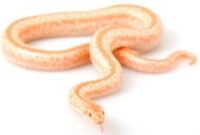
Albino snakes are the outset that were discovered in the wild. This means they were the original 'morph'. At the time, they were valuable, because the simply other corn snakes kept equally pets were the wild-type.
These corn snakes get their proper name from lacking melanin in their skin. Albino corn snakes lack melanin, which is what gives skin a dark tone. This means that albinos have:
- Cream-to-calorie-free orange colour
- Orange-scarlet saddles in a normal pattern
- Pink or red eyes
People think that albino snakes are completely white, but that'due south non true. They notwithstanding have some color in their skin/scales considering melanin isn't the only paint snakes accept.
Because they've been available for years, albino corn snakes aren't expensive to buy. You tin get one for between $twoscore and $50.
Sunglow

Sunglows are a kind of selectively bred amelanistic. 'Selectively bred' means that they're non a designer morph, and they're not a wild morph. Instead, it means that breeders have created successive generations and bred them for particular traits.
This is a common do in pets. Say, for instance, that you want to breed a big corn serpent. Every generation, you would selection the biggest corn snake of the hatch and brood only that. Afterwards several generations, all the corn snakes of each litter will exist bigger.
That's what breeders did with a sunglow. The but difference is that they bred albinos together until they got rid of the white speckling that appears. They also selected a vivid background color.
This means that sunglows are like meliorate-looking albinos. They have an orange groundwork and dark orangish saddle marks. They develop fewer or no white speckles as they age. Their color is bright and striking, and they take the same pink or red optics as albinos.
They cost the aforementioned as regular albinos at $40 to $l.
Okeetee

Okeetees are another wild morph. They were but slightly different from regular corn snakes. Just they take been selectively bred to highlight their differences to normals.
Okeetees were first found in Jasper County, S Carolina. They are named after the Okeetee Hunt Club, the members of which first found these snakes.
They are the same color as normal corn snakes, but brighter. In that location is more contrast between their ground colors and saddles. They are bright orange with deep scarlet saddles, almost maroon. The border around the saddles is blackness and thick.
Considering these snakes are withal rare in the trade, they cost betwixt $60-$100. Extreme Okeetees, which have been bred to highlight their colors and design, can price more money.
Anerythristic (Anery)
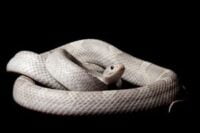
Anerythristic snakes are similar in type to albinos, but non in appearance. What that means is that they lack a pigment too. Only the pigment anerys lack is erythrin.
Erythrin is the paint that gives a ophidian red coloration. As reddish is the main colour of a corn ophidian, this leaves the anery with almost no color at all.
They however have melanin in their skin which gives them a greyness advent overall. Their background color is a calorie-free gray, and their saddles are a slightly darker gray. There are two kinds of anery which are slightly dissimilar:
- Type A anery. These are lite in color with a stark dissimilarity in their design. Their markings may have a slight brownish tint. They become more yellow as they age.
- Type B anery. Type B anerys are darker grey with less dissimilarity. They have no brown hint, and don't yellow as they age. They are likewise known as charcoal corn snakes.
This morph has been on the market for a long time. That's why they're inexpensive, at just $fifty to $60.
Lavender
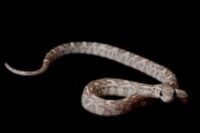
These snakes are the kickoff compound morph/designer morph in our listing. A designer morph is i that was bred from two existing morphs. It can't be found in the wild, and tin can only exist created by breeders.
Lavender corn snakes are a silver-gray colour with a peach or pink tint. Their saddles are purple-gray and outlined in gray or brownish.
These snakes start life darker and fade into lighter colors as they age. Equally they get older, their pink and lavender get-go to come through.
While they're cute, lavender corn snakes have been available for many years. So, you lot can buy 1 for betwixt $twoscore and $80.
Caramel
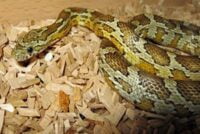
Caramel corns are another pretty morph. They have less red, but more yellow in their scales. This results in a tan or gray background colour. This snake's saddles range from bright yellow to a medium chocolate-brown.
Juveniles are slightly different. They're redder, merely this fades as they age. The caramel corn snake is a favorite of breeders, too. It's used to create many designer morphs, and is bred with other morphs including hypomelanistics (hypos), butters, and more.
You tin can buy them for between $30 and $seventy.
Blood Red
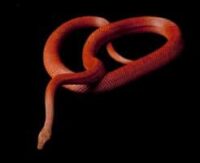
The blood-red corn snake (or bloodred corn ophidian as some breeders prefer) is a vivid, deep red color. These snakes were selectively bred from wild-type corns, which were selected for their ruby-red markings.
Over time, this convenance made the markings deeper and brighter. Also selected for was the size of the markings, until they covered the whole trunk. So, this snake doesn't have a pattern like normal corn snakes do.
Hatchlings start out life looking entirely normal. But over fourth dimension, the redness of their markings deepens and their background color fades. These snakes cost between $70-100.
Blizzard
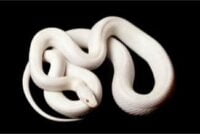
Blizzard corn snakes are entirely white. People think albinos are white, when they're pink and orange. Blizzard corn snakes are a true snowfall-white color from olfactory organ to tail.
Meliorate nevertheless, they take no pattern. So, their whole body is entirely white. They are a designer morph bred from an albino and a type B anery (charcoal corn snake). The albino lacks melanin, while the anery lacks erythrin. This means that the blizzard has no pigmentation at all.
The only standout feature is the snake's pink eyes and red pupils. These it inherits from its albino parent.
Juveniles are the most beautiful. They are pure white. As the snake ages, information technology can develop yellow patches around its throat and abdomen. These are from carotenoids in its nutrient, which build up over time. Every bit these snakes are becoming more common, they cost between $70 and $100.
Palmetto
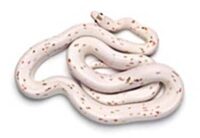
Palmetto corn snakes are equally white as a blizzard corn ophidian. But unlike the blizzard, they accept a pretty pattern. They are dotted from nose to tail with small flecks of different colors.
Surprisingly, the first palmetto was wild-caught. It looks so special that people assume it'south a designer morph, only information technology's not. A male was first caught at the end of the 2009 breeding season and shipped to South Mount Reptiles.
This first palmetto was bred with an amel (amelanistic, i.e. albino). It was shortly discovered that the palmetto is a variant of the leucistic cistron. The morph is named because it was caught in South Carolina, which is the 'Palmetto Land'.
Some breeders don't think that the palmetto is a true corn snake. They believe information technology may exist the result of interbreeding with another rat snake. Equally of yet, DNA testing hasn't been done to see whether that's the instance.
The colour of the palmetto's flecks depends on the morph information technology's bred with. A palmetto with normal genes has reddish, brown and orange spots. But a butter palmetto has flecks of yellowish. Because they're unique and were just recently bred, these snakes cost between $600 and $1500.
Stripe
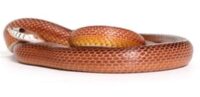
The stripe corn ophidian morph affects the design, not color. This morph has thin stripes that run from the head to the tail. Information technology doesn't have any saddles at all.
Because this morph only affects the design, it can be bred to snakes of whatever colour. So, a wild-type corn snake with the stripe morph has an orange ground colour with red stripes. The color of the saddles is what becomes the color of the stripes in these snakes.
These snakes aren't that mutual, but aren't as sought later as other morphs either. This ways they but price between $twoscore and $60.
Scaleless

The scaleless morph is perhaps the most interesting. It's definitely popular. It lacks scales on its dorsum, apart from 1 over each eye. Its skin, which is normally underneath the scales, is exposed. Its belly still has some scales, though.
Scaleless snakes acquired disagreements when they were first kept every bit pets. Some owners disagreed with breeding them, thinking that it's vicious, or that they couldn't survive in the wild.
Simply these aren't a designer morph or selectively bred. The beginning scaleless snakes of other species were captured in the wild in 1942. This was followed past scaleless snakes of other species in the following decades.
The scaleless corn snake, though, was selectively bred. It is the result of breeding some other scaleless species of rat snake to a corn snake. This created something similar a jungle corn, the result of ii species interbreeding.
This interesting history is enough to make scaleless corn snakes interesting on its own. But these snakes tin have any color and pattern. It's the skin that contains these pigments, not the scales, so in all other ways, they're normal.
This means there are lots of scaleless designer morphs. Depending on what kind you want, you tin pay upward of $200 for i.
Opale
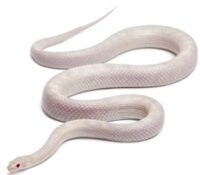
Opale corn snakes are some other light-colored serpent. They're a designer morph bred from lavender and amelanistic genes. These two morphs are recessive, which makes the opal a double recessive corn snake. This morph is one of the older ones. It has existed since at least the late 1990s.
These look like blizzards when they're mature, and have pinkish or purple highlights. They're best described as beingness like a stake albino with a faded pattern. They're most colorful every bit juveniles, but tin lose some of this colour equally they age into adults.
Their colour starts off as bright pastel shades of orangish, pink and lavender. This is mostly in the basis colour. Blotches are lighter, even white.
Equally they age, the design is difficult to spot. It's at that place, but it has little contrast. This allows the beauty of this morph's colors to shine through.
These snakes sell for $70-$fourscore. But they tin can also exist found as designer morphs, e.g. opale tesseras, which cost considerably more money.
Hypomelanistic

The hypomelanistic corn snake, better known as a hypo, is a common morph. Information technology'south best described as a lite-colored version of the regular corn snake. Its color and design are roughly the aforementioned, but some of the black pigment is taken abroad.
Considering these snakes are so like to wild-types, some people have trouble telling them apart. But once you're familiar with them, it'southward piece of cake.
What makes hypos dandy is that they're commonly used to create designed morphs. They can exist bred with lots of other morphs to create slightly dissimilar colour combinations to normals. These snakes are commonly found, so they are about $50 to buy.
Pied
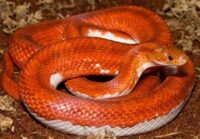
Piebald, or pied corn snakes are another pattern morph. Merely in a mode, they're a color morph likewise. Pied corn snakes are wild-caught originally. But they accept been selectively bred to emphasize their qualities.
Pied corn snakes have been effectually since the 1970s at to the lowest degree. However, these start snakes weren't successful because the piebald mutation was fatal when bred. Meliorate genetic examples were found later on, and are the origin of today's pied corn snakes.
These snakes have large white sections interspersed with islands of color. The white of these snakes is a true white, not like albino 'white'. It tin can announced anywhere along the body. These aren't as common as the pied versions of other snake species.
Between the white sections are the serpent'southward normal colors. On a pied wild-type ophidian, these colors would be regular orange, dark-brown and ruby. But you can breed pied snakes with any other morph to create lots of colors.
There are also different forms of piebaldism. One is as described above, but you lot can also find pied-sided snakes. These have white patches on their sides and bellies, and orangish-ruddy backs. These have get more popular in recent years. Yous can buy them for $150+.
Jungle

The jungle corn is a highly variable outcome of breeding a corn snake and a California kingsnake. These can exist bred safely, and sometimes even breed in the wild.
You can breed these snakes together considering they're non distantly related. They are both colubrids, but are from different genera. Unremarkably, two animals from different genera can't have fertile offspring. But these snakes can.
That's considering the colubrid family is diverse. Information technology has been described by biologists as like a large bin—where all snakes which tin can't be classified elsewhere are dumped in. And so, information technology'due south likely that these snakes are closer related than scientists realize.
These snakes have extreme pattern variations. That's because they accept some pattern genes from the corn snake side, and some from the kingsnake side. Some take big saddles with tiny stripes between. Others have saddles the same size as the stripes.
The colour of these snakes is variable too. Some have deep brown saddles with a traffic-light-red blush. Others take orange saddles with a tan blush. The ground color is usually tan. These snakes aren't the most mutual, so they are betwixt $50 and $100.
Yous can likewise find 'tri-color' jungle corns. These are the result of breeding a Querétaro kingsnake with a corn ophidian. They expect like albinos.
Gopher/Turbo
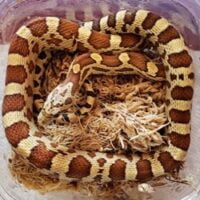
The turbo corn is another crossbreed. The gopher corn is the offspring of a gopher snake and a corn serpent. But some breeders call up that whatsoever ophidian of the Pituophis genus (including gopher snakes, pino snakes, and bull snakes) will do.
The color and patternation of hybrids all vary based on their parent species, so each snake is completely unique. Hither are some of their features:
- Heavy-bodied. Gopher snakes are thicker and heavier than corn snakes, and this is passed on to gopher corns.
- Long. They grow quickly, getting big for their age compared to normal corn snakes. They end up much bigger.
- Thicker tails. These they inherit from the gopher side, too.
You don't see many of these snakes around anymore, then the price is higher than normal. Y'all can buy them for about $100.
Tessera
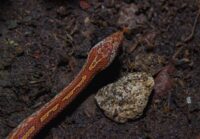
The tessera morph is some other pattern morph. Information technology'south an interesting mix that has an attractive dorsal stripe. The center of this stripe is the light background color, bordered with thick blackness lines. On the outside of this stripe are a pair of even thicker brick red lines.
Simply that's not all that this morph has. Its sides are interesting also. Its sides have a slightly irregular pattern to them. The pattern is composed of normal saddles, which are broken upward and vary in size and shape.
Some people call up that the tessera is a hybrid morph, i.eastward. the result of interbreeding. That'south because several species like garter snakes and kingsnakes have the same tessera pattern. Still, most breeders retrieve it'south a pure corn snake.
Tesseras are some other snake that originates from South Mount Reptiles. They were get-go bred by Don Soderberg in 2008. They have since been bred by other breeders also, then have gone downwardly in price.
Because this is a pattern morph, tessera snakes tin can be any colour. Normal tesseras are the color of normal corn snakes, but you can find them in any colour from albino to butter. The first designer morphs were made by Richard Hume of Unique Serpents in 2011.
The more common types can exist bought for as little as $100, simply the rarer varieties fetch upwards of $thou.
Butter
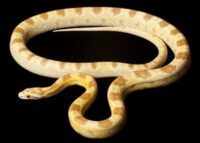
A butter corn serpent is another designer morph. It'southward the result of breeding a caramel corn serpent with an albino.
These snakes are a sunny yellowish color. Their ground color is a light xanthous, while their saddles are a deeper xanthous. There is deviation plenty in the yellows that the pattern is easily visible. But because information technology's yellow all over, it's squeamish-looking.
These snakes are fairly common, so they aren't expensive. You can option ane up for $50.
Orchid
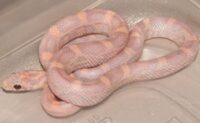
The orchid corn snake has a recessive gene which looks a picayune similar an albino in juveniles. They are flossy pink with light yellow or orangish stripes between their saddles. Only their colors alter as they grow older into something different.
This morph is the result of breeding a lavender and a sunkissed together. That's why the orchid has the same low-cal regal, blue and pinkish hues as the lavender. Both of these morphs are recessive.
Something interesting near this morph is that one stop tin wait like lavander, and the other similar a sunkissed. So, the head end might have a light orange color saddles with a light lavender background. But towards the tail end and middle, this orange disappears.
At the tip of the tail, the saddles are a slightly darker lavender. This gives the snake a unique two-tone look. In other snakes, the lite orange groundwork with lavander saddles and sides extends all along the body.
Considering of this and their rarity, these snakes are expensive. You lot can buy one for $300.
Amel Orchid
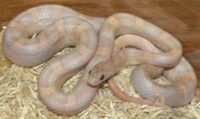
The amel orchid corn ophidian has 3 traits. It has the traits of the lavender and sunkissed morphs, as the orchid corn ophidian parents do. But this orchid is then bred with an amel (albino). Each of these traits is recessive, so they can coexist.
Its ground color is candy pinkish, merely its saddles are only slightly darker. This gives information technology a bright pink overall appearance. Its eyes are pinkish-ruby-red as well, like all snakes that have amelanistic genes. You should expect to pay near $150.
Ghost

The 'ghost' morph is another designer morph. This i is created by breeding an anerythristic (Type A) ophidian and a hypomelanistic ophidian together. Their colors include a mid-gray to white ground color with chocolate-brown saddles.
These snakes have a high level of blush in their saddles. The centre of the blush is the same mid-grey every bit their ground color. As is often the case, the saddles are lightly outlined in a darker color (between blackness and brown) which makes them stand out.
These snakes look a lot like their anerythristic parents. They can be difficult to tell apart, almost incommunicable with some specimens. The best mode to tell the divergence is to look at the borders of their saddles.
An Anery Type A has deep black saddle borders that stand in stark dissimilarity to their ground colors. A ghost has dark borders to its saddles as well, but these are less distinct. They also range between black and mid-brown. These snakes are widely bachelor, and so you may find one for between $50-100.
Motley
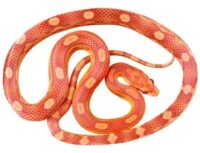
A motley corn serpent has a few unique features that make them stand out. It'due south a pattern morph that can come in any color.
Dissimilar many other morphs, they take clear bellies. Their sides are cleaner than the wild type, and don't feature secondary patterns between their saddle markings. Their colors are the same as usual.
Hatchlings are vibrant in color, but these snakes get duller equally they get older. Their hatchling colors are a mid-grayness to brown ground color, with deep brick red saddles with slight blush running along their backs. The colour betwixt the saddles is tan even if the serpent's sides are gray.
As they get older, these snakes become a mid-orange colour all over. Their saddles are just slightly darker than the rest of their backs.
Interestingly, this morph is allelic with the stripe morph. That means the cistron mutation is in the same identify as the one which causes the stripe morph. The motley factor is dominant, which ways that if a snake has both the stripe and motley genes, it's the motley ane that will shape its appearance. They cost from $65, just the rarer ones tin fetch hundreds of dollars.
Anery Stripe

An anery stripe is a designer morph created past breeding an anerythristic snake with a stripe snake. The result is one of the highest-contrast corn serpent morphs.
These snakes have the usual anery color combination. They take a calorie-free grayness ground colour with darker gray, even black pattern. This solitary makes information technology a hit serpent to wait at.
But it's the stripe morph'due south pattern that makes this snake even more loftier-contrast and interesting to look at. Rather than saddles or spots, this snake has a stripe or stripes running along its back. These run from its olfactory organ to its tail.
In some of these snakes, the stripes are muddy and indistinct. Merely in the best specimens, its stripes are straight, deep black and clearly defined. The clearer the pattern, the more this snake will sell for. But these snakes are difficult to discover, so you lot could pay between $50 and $100 for one.
Opposite Okeetee
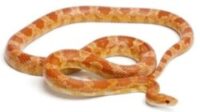
A opposite Okeetee is a kind of albino corn serpent. This alone makes them interesting. But they have a fascinating genetic history which makes them an interesting morph indeed.
They have a pale orangish basis color with bright cherry-red saddles. Their saddles are surrounded by white rather than black, which is where they get the 'reverse' role of their name from. Like all amelanistic snakes, they accept pink to red eyes.
So, they accept amelanistic genes. And from their morph proper noun, you may recollect that they're amelanistic snakes bred with Okeetees. They have the thick saddle bands and vivid red saddles, like Okeetees practice. But they don't accept Okeetee genes.
Instead, they're selectively bred amelanistic snakes. They were bred to select for brighter red saddles and thicker bands around them. Then, while they wait similar an amelanistic ophidian bred with an Okeetee, they're not. These snakes are less easy to observe, and so they sell for between $85 and $100.
Orangish Creamsicle
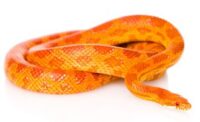
These snakes are another example of crossbred snake morphs. Orange creamsicles are the result of breeding a regular corn snake with a Neat Plains rat snake (Pantherophis Emoryi).
Orange creamsicles have soft orange saddle markings, and a xanthous or light orange basis color. This makes them similar to amelanistic corn snakes, and this should give you a clue as to how they're bred. This morph is what y'all get when yous breed an albino corn serpent with an albino Great Plains rat ophidian.
It is also possible to breed ii wild-type versions of these snakes together. This combination is called a rootbeer corn snake.
You tin breed them together considering corn snakes and Swell Plains rat snakes 2 species within the same genus (Pantherophis). That ways they're closely related. Oftentimes, two animals of different species can't breed together. But these species can.
These corn snakes aren't common, simply aren't likewise uncommon a morph either. Y'all can discover a specimen for around $fourscore.
Miami
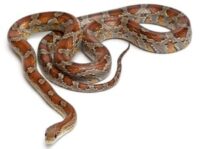
The Miami corn ophidian is another locality morph. This means it's a unique variant of the species from a item identify, like the Okeetee. Equally yous can gauge, it's from the area around Miami.
A Miami corn serpent has a silver or grey ground colour, with saddles that range from orange to dark red. These occur naturally, although some specimens have been selectively bred to emphasize this ophidian'south unique qualities (due east.g. greyer ground color, brighter saddles).
What makes this snake interesting is that some people think it'due south a morph, and some people don't. In that location'due south disagreement in the corn ophidian community as to whether its traits can be inherited or non. Some people recollect they tin be, others say they can't.
These snakes aren't common because breeders aren't that interested in them. Only because they don't take crazy colors, they're yet non that expensive. You lot can find them for auction for $l.
Strawberry Snow
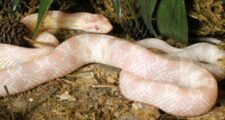
This is a designer morph made by breeding a strawberry with a snow. Equally snows are white, and strawberries are carmine, the result is a pink snake.
Its background colour is a soft pastel pink bordering on white with a hint of color to it. Its saddles are a muted bubblegum pink. Because of this low level of contrast, from a distance, they look pure pink with mottled spots.
And because these snakes take amelanistic genes, their optics are pink as well. This gives the snake one overall color, which is rare with any color morph.
Like others on our list, these snakes are uncommon, so you might only find them with other morphs bred into them (e.one thousand. a pattern morph similar tessera). You lot could pay anywhere north of $100 if at that place are lots of extra morphs added into its genes.
Corn Snake Morph Price List
| Albino | Cream or low-cal orange groundwork color with orangish-red saddles and pink or carmine eyes. | $twoscore – $50 |
| Sunglow | A selectively bred amelanistic (albino) snake with no speckling and brighter basis color. | $twoscore – $fifty |
| Okeetee | A locality morph, i.e. a morph from a particular place. Brighter colors and thicker borders around the saddles. | $60 – $100 |
| Anery | Anerythristic corn snakes are two-tone gray. | $50 – $threescore |
| Lavander | Silvery-grey with a peach or pink tint. Purple-gray saddles with a gray or brown outline. | $40 – $80 |
| Caramel | Less red and more yellow than normal. Tan or gray groundwork color with bright xanthous to medium-chocolate-brown saddles. | $xxx – $70 |
| Blood Red | Brilliant, deep carmine. Selectively bred from wild-type corns. | $70 – $100 |
| Blizzard | Entirely white from olfactory organ to tail. Pink or ruby-red optics, which come up from the snake'due south albino genes. | $70 – $100 |
| Palmetto | Pure white with colorful specks throughout. | $600 – $1500 |
| Stripe | A pattern morph that has stripes from nose to tail instead of saddles. | $40 – $60 |
| Scaleless | It can exist whatsoever color or pattern, but doesn't have scales. The color and design are in the pare, not the scales, of a corn snake. | $200+ |
| Opale | Await like blizzards simply with pink or imperial highlights. | $lxx – $80 |
| Pied | A pattern morph. It has regular color and blueprint, just interrupted by big pure white areas. | $50+ |
| Jungle | The offspring of a corn snake bred with a California kingsnake. Large-bodied with an irregular blueprint. | $50 – $100 |
| Turbo | The offspring of a corn snake bred with a gopher serpent. Heavy-bodied with an irregular design. | $100+ |
| Tessera | The pattern is cleaved up similar static. | $100 – $k |
| Butter | More yellowish and light orange than a normal corn snake. | $50+ |
| Orchid | Light purple, bluish and pink like a lavender. May too have a 'sunkissed' section to its torso: its front end 1 morph, its back stop the other. | $300+ |
| Amel | Like an orchid corn snake, merely amelanistic. Candy pinkish with slightly darker saddles. | $100 – $150 |
| Ghost | Mid-grey to white ground color with brown saddles and a high level of ground color chroma. | $l – $100 |
| Motley | Clear bellies and clear sides, with normal colors. | $65 – $300 |
| Anery Stripe | Mid-grayness basis color with stripes from caput to tail. High dissimilarity. | $fifty – $100 |
| Opposite Okeetee | A kind of amelanistic corn snake. Brighter colors and thicker saddles. No true Okeetee genes: this morph was selectively bred from albino stock. | $85 – $100 |
| Orange Creamsicle | An orange corn ophidian crossbred from a corn snake and a Great Plains rat serpent. | $lxxx+ |
| Reverse Okeetee | A kind of amelanistic corn snake. Brighter colors and thicker saddles. No truthful Okeetee genes: this morph was selectively bred from albino stock. | $85 – $100 |
| Orange creamsicle | An orange corn snake crossbred from a corn snake and a Great Plains rat ophidian. | $fourscore+ |
| Miami | A locality morph from around Miami. Silverish or gray ground color with orangish-dark red saddles. May be an inheritable morph (some breeders recall it isn't). | $50+ |
| Strawberry | A pattern morph with clear bellies and articulate sides. Blurs the saddle borders with the ground colour. A bright pastel pink snake with albino genes. | $100+ |
Aside from this listing, how many corn snake morphs are there? There are hundreds, each of which has a unique colour or pattern.
Whether you spend $20 on a "normal" colored serpent or $chiliad on a designer morph, you'll still stop upwards with a beautiful pet snake. Here's our consummate guide to corn snake care.
What Does a Baby Corn Snake Look Like
Source: https://www.snakesforpets.com/best-corn-snake-morphs/
0 Response to "What Does a Baby Corn Snake Look Like"
Post a Comment