17 What Role Does the Counterreformation Play in the Development of Italian Baroque Art?

Hans Holbein the Younger's Noli me tangere a relatively rare Protestant oil painting of Christ from the Reformation period. Information technology is small, and generally naturalistic in style, avoiding iconic elements like the halo, which is barely discernible.
The Protestant Reformation during the 16th century in Europe most entirely rejected the existing tradition of Catholic art, and very oft destroyed as much of it as it could reach. A new creative tradition adult, producing far smaller quantities of fine art that followed Protestant agendas and diverged drastically from the southern European tradition and the humanist fine art produced during the High Renaissance. The Lutheran churches, equally they developed, accepted a limited role for larger works of art in churches,[1] [2] and also encouraged prints and book illustrations. Calvinists remained steadfastly opposed to art in churches, and suspicious of pocket-sized printed images of religious subjects, though by and large fully accepting secular images in their homes.
In turn, the Cosmic Counter-Reformation both reacted against and responded to Protestant criticisms of fine art in Roman Catholicism to produce a more stringent mode of Cosmic art. Protestant religious art both embraced Protestant values and assisted in the proliferation of Protestantism, only the amount of religious art produced in Protestant countries was hugely reduced. Artists in Protestant countries diversified into secular forms of art like history painting, landscape painting, portrait painting and nonetheless life.
Art and the Reformation [edit]


The Protestant Reformation was a religious move that occurred in Western Europe during the 16th century that resulted in a dissever in Christianity betwixt Roman Catholics and Protestants. This motion "created a Northward-South split in Europe, where generally Northern countries became Protestant, while Southern countries remained Cosmic."[three]
The Reformation produced two principal branches of Protestantism; one was the Evangelical Lutheran churches, which followed the teachings of Martin Luther, and the other the Reformed Churches, which followed the ideas of John Calvin and Huldrych Zwingli. Out of these branches grew iii main sects, the Lutheran tradition, likewise as the Continental Reformed and Anglican traditions, the latter ii post-obit the Reformed (Calvinist) faith.[4] Lutherans and Reformed Christians had different views regarding religious imagery.[5] [2]
Martin Luther in Germany allowed and encouraged the brandish of a restricted range of religious imagery in churches, seeing the Evangelical Lutheran Church equally a continuation of the "ancient, apostolic church".[2] The use of images was one of the issues where Luther strongly opposed the more radical Andreas Karlstadt. For a few years Lutheran altarpieces similar the Last Supper by the younger Cranach were produced in Germany, especially past Luther'due south friend Lucas Cranach, to supercede Cosmic ones, frequently containing portraits of leading reformers as the apostles or other protagonists, but retaining the traditional depiction of Jesus. Every bit such, "Lutheran worship became a complex ritual choreography ready in a richly furnished church interior."[ane] Lutherans continued the apply of the crucifix every bit it highlighted their high view of the Theology of the Cantankerous.[two] [6] Stories grew upwardly of "indestructible" images of Luther, that had survived fires, by divine intervention.[seven] Thus, for Lutherans, "the Reformation renewed rather than removed the religious image."[eight]
On the other manus, there was a wave of iconoclasm, or the devastation of religious imagery. This began very early on in the Reformation, when students in Erfurt destroyed a wooden altar in the Franciscan friary in December 1521.[ix] Later on, Reformed Christianity showed consistent hostility to religious images, as idolatry, specially sculpture and large paintings. Volume illustrations and prints were more acceptable, because they were smaller and more individual. Reformed leaders, peculiarly Huldrych Zwingli and John Calvin, actively eliminated imagery from churches inside the command of their followers, and regarded the bully bulk of religious images as idolatrous.[10] Early Calvinists were even suspicious of portraits of clergy; Christopher Hales (soon to be ane of the Marian exiles) tried to have portraits of six divines sent to him from Zurich, and felt it necessary to explain his motives in a letter of 1550: "this is not washed ....with a view to making idols of you; they are desired for the reasons which I have mentioned, and not for the sake of accolade or veneration".[11]
The devastation was often extremely divisive and traumatic within communities, an unmistakable physical manifestation, often imposed from to a higher place, that could not be ignored. It was simply for this reason that reformers favoured a single dramatic coup, and many premature acts in this line sharply increased subsequent hostility between Catholics and Calvinists in communities – for it was generally at the level of the city, town or village that such deportment occurred, except in England and Scotland.
Merely reformers often felt impelled by strong personal convictions, as shown by the case of Frau Göldli, on which Zwingli was asked to advise. She was a Swiss lady who had one time fabricated a hope to Saint Apollinaris that if she recovered from an affliction she would donate an image of the saint to a local convent, which she did. Later she turned Protestant, and feeling she must reverse what she now saw as a wrong activeness, she went to the convent church building, removed the statue and burnt it. Prosecuted for irreverence, she paid a small fine without complaint, but flatly refused to pay the additional sum the court ordered exist paid to the convent to supersede the statue, putting her at take chances of serious penalties. Zwingli'south letter brash trying to pay the nuns a larger sum on condition they did not replace the statue, but the eventual outcome is unknown.[12] Past the end of his life, after iconoclastic shows of force became a feature of the early phases of the French Wars of Religion, even Calvin became alarmed and criticised them, realizing that they had get counter-productive.[13]
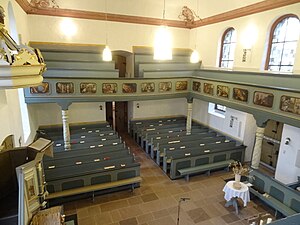
Daniel Hisgen's paintings are generally cycles on the parapets of Lutheran church galleries. Here the Cosmos (left) to the Declaration can be seen.
Subjects prominent in Cosmic art other than Jesus and events in the Bible, such every bit Mary and saints were given much less emphasis or disapproved of in Protestant theology. Equally a event, in much of northern Europe, the Church about ceased to commission figurative art, placing the dictation of content entirely in the hands of the artists and lay consumers. Calvinism even objected to not-religious funerary fine art, such as the heraldry and effigies beloved of the Renaissance rich.[xiv] Where there was religious art, iconic images of Christ and scenes from the Passion became less frequent, as did portrayals of the saints and clergy. Narrative scenes from the Bible, specially every bit book illustrations and prints, and, after, moralistic depictions of modern life were preferred. Both Cranachs painted emblematic scenes setting out Lutheran doctrines, in item a series on Law and Gospel. Daniel Hisgen, a German Rococo painter of the 18th century in Upper Hesse, specialized in cycles of biblical paintings decorating the front of the gallery parapet in Lutheran churches with an upper gallery, a less prominent position that satisfied Lutheran scruples. Wooden organ cases were besides frequently painted with similar scenes to those in Catholic churches.
Lutherans strongly dedicated their existing sacred art from a new wave of Calvinist-on-Lutheran iconoclasm in the second half of the century, every bit Calvinist rulers or city authorities attempted to impose their volition on Lutheran populations in the "Second Reformation" of about 1560–1619.[ii] [15] Confronting the Reformed, Lutherans exclaimed: "You lot black Calvinist, you give permission to blast our pictures and hack our crosses; we are going to smash you and your Calvinist priests in return".[ii] The Beeldenstorm, a large and very disorderly wave of Calvinist mob devastation of Catholic images and church fittings that spread through the Low Countries in the summer of 1566 was the largest outbreak of this sort, with drastic political repercussions.[16] This campaign of Calvinist iconoclasm "provoked reactive riots by Lutheran mobs" in Germany and "antagonized the neighbouring Eastern Orthodox" in the Baltic region.[17] Like patterns to the German actions, but with the addition of encouragement and sometimes finance from the national authorities, were seen in Anglican England in the English language Civil War and English Commonwealth in the adjacent century, when more damage was done to art in medieval parish churches than during the English language Reformation.
A major theological difference between Protestantism and Catholicism is the question of transubstantiation, or the literal transformation of the Communion wafer and wine into the body and blood of Christ, though both Lutheran and Reformed Christians affirmed the real presence of Christ in the Eucharist, the former as a sacramental union and the latter as a pneumatic presence.[18] Protestant churches that were not participating in the iconoclasm often selected as altarpieces scenes depicting the Last Supper. This helped the worshippers to recall their theology behind the Eucharist, equally opposed to Catholic churches, which often chose crucifixion scenes for their altarpieces to remind the worshippers that the sacrifice of Christ and the sacrifice of the Mass were one and the same, via the literal transformation of the Eucharist.
The Protestant Reformation also capitalized on the popularity of printmaking in northern Europe. Printmaking allowed images to be mass-produced and widely available to the public at low cost. This allowed for the widespread availability of visually persuasive imagery. The Protestant church was therefore able, every bit the Catholic Church had been doing since the early 15th century, to bring their theology to the people, and religious educational activity was brought from the church building into the homes of the common people, thereby forming a direct link between the worshippers and the divine.
In that location was besides a fierce propaganda war fought partly with pop prints by both sides; these were oft highly scurrilous caricatures of the other side and their doctrines. On the Protestant side, portraits of the leading reformers were popular, and their likenesses sometimes represented the Apostles and other figures in Biblical scenes such every bit the Concluding Supper.
Genre and landscape [edit]
Later the early on years of the reformation, artists in Protestant areas painted far fewer religious subjects for public display, although there was a conscious endeavour to develop a Protestant iconography of Bible analogy in volume illustrations and prints. In the early Reformation artists, specially Cranach the Elder and Younger and Holbein, fabricated paintings for churches showing the leaders of the reformation in ways very similar to Catholic saints. Subsequently Protestant taste turned from the display in churches of religious scenes, although some continued to exist displayed in homes. In that location was also a reaction against large images from classical mythology, the other manifestation of high style at the time. This brought about a style that was more directly related to accurately portraying the present times. The traditions of landscapes and genre paintings that would fully flower in the 17th century began during this period.
Peter Bruegel (1525–1569) of Flemish region is the great genre painter of his time, who worked for both Catholic and Protestant patrons. In near of his paintings, even when depicting religious scenes, most space is given to landscape or peasant life in 16th century Flanders. Bruegel'south Wedding ceremony Feast, portrays a Flemish-peasant wedding ceremony dinner in a barn, which makes no reference to any religious, historical or classical events, and merely gives insight into the everyday life of the Flemish peasant. Another great painter of his age, Lucas van Leyden (1489–1533), is known more often than not for his engravings, such as The Milkmaid, which depicts peasants with milk cows. This engraving, from 1510, well before the Reformation, contains no reference to religion or classicism, although much of his other work features both.

Bruegel was also an accomplished mural painter. Frequently Bruegel painted agricultural landscapes, such as Summer from his famous ready of the seasons, where he shows peasants harvesting wheat in the land, with a few workers taking a dejeuner pause under a nearby tree. This type of landscape painting, obviously void of religious or classical connotations, gave birth to a long line of northern European landscape artists, such every bit Jacob van Ruisdael.
With the great development of the engraving and printmaking market in Antwerp in the 16th century, the public was provided with attainable and affordable images. Many artists provided drawings to volume and print publishers, including Bruegel. In 1555 Bruegel began working for The Four Winds, a publishing house owned by Hieronymus Cock. The Iv Winds provided the public with well-nigh a yard etchings and engravings over two decades. Between 1555 and 1563 Bruegel supplied Erect with almost 40 drawings, which were engraved for the Flemish public.
The courtly style of Northern Mannerism in the second one-half of the century has been seen as partly motivated past the desire of rulers in both the Holy Roman Empire and France to find a style of art that could entreatment to members of the courtly elite on both sides of the religious split up.[19] Thus religious controversy had the rather ironic effect of encouraging classical mythology in art, since though they might disapprove, even the most stern Calvinists could non credibly claim that 16th century mythological art really represented idolatry.
Council of Trent [edit]
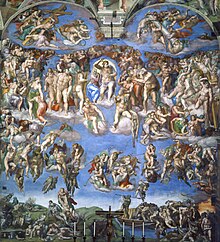
During the Reformation a great deviation arose between the Catholic Church and the Protestant Reformers of the due north regarding the content and style of fine art work. The Catholic Church viewed Protestantism and Reformed iconoclasm as a threat to the church building and in response came together at the Council of Trent to institute some of their own reforms. The church felt that much religious art in Catholic countries (especially Italy) had lost its focus on religious field of study-matter, and became too interested in material things and decorative qualities. The quango came together periodically between 1545 and 1563. The reforms that resulted from this council are what prepare the basis for what is known as the Counter-Reformation.
Italian painting after the 1520s, with the notable exception of the fine art of Venice, developed into Mannerism, a highly sophisticated manner, striving for consequence, that concerned many churchman as lacking appeal for the mass of the population. Church pressure to restrain religious imagery affected art from the 1530s and resulted in the decrees of the final session of the Council of Trent in 1563 including brusk and rather inexplicit passages concerning religious images, which were to have smashing touch on the development of Catholic art. Previous Catholic Church councils had rarely felt the need to pronounce on these matters, different Orthodox ones which take oft ruled on specific types of images.
Statements are ofttimes made along the lines of "The decrees of the Council of Trent stipulated that art was to be directly and compelling in its narrative presentation, that it was to provide an authentic presentation of the biblical narrative or saint's life, rather than adding incidental and imaginary moments, and that it was to encourage piety",[20] but in fact the bodily decrees of the council were far less explicit than this, though all of these points were probably in line with their intentions. The very curt passage dealing with art came only in the final session in 1563, every bit a final minute and little-discussed addition, based on a French draft. The decree confirmed the traditional doctrine that images only represented the person depicted, and that veneration to them was paid to the person themself, not the prototype, and farther instructed that:
...every superstition shall exist removed ... all lasciviousness be avoided; in such wise that figures shall not be painted or adorned with a beauty heady to lust... there be nothing seen that is disorderly, or that is unbecomingly or confusedly bundled, naught that is profane, nothing indecorous, seeing that holiness becometh the house of God. And that these things may exist the more faithfully observed, the holy Synod ordains, that no ane be allowed to place, or cause to exist placed, any unusual image, in any place, or church building, howsoever exempted, except that image have been approved of by the bishop ...[21]
The number of decorative treatments of religious subjects declined sharply, as did "unbecomingly or confusedly arranged" Mannerist pieces, as a number of books, notably by the Flemish theologian Molanus, Saint Charles Borromeo and Key Gabriele Paleotti, and instructions by local bishops, amplified the decrees, often going into minute detail on what was acceptable. Many traditional iconographies considered without adequate scriptural foundation were in issue prohibited, as was any inclusion of classical pagan elements in religious art, and almost all nudity, including that of the infant Jesus.[22] Co-ordinate to the great medievalist Émile Mâle, this was "the death of medieval art".[23]
Art and the Counter-Reformation [edit]

While Calvinists largely removed public fine art from religion and Reformed societies moved towards more "secular" forms of art which might be said to glorify God through the portrayal of the "natural dazzler of His cosmos and past depicting people who were created in His epitome",[24] Counter-Reformation Cosmic church continued to encourage religious art, but insisted information technology was strictly religious in content, glorifying God and Catholic traditions, including the sacraments and the saints.[25] Also, "Lutheran places of worship incorporate images and sculptures not only of Christ but also of biblical and occasionally of other saints as well equally prominent decorated pulpits due to the importance of preaching, stained glass, ornate furniture, magnificent examples of traditional and modern architecture, carved or otherwise embellished altar pieces, and liberal employ of candles on the chantry and elsewhere."[26] The main difference between Lutheran and Roman Catholic places of worship was the presence of the tabernacle in the latter.[26]
Sydney Joseph Freedberg, who invented the term Counter-Maniera, cautions against connecting this more than ascetic mode in religious painting, which spread from Rome from about 1550, too directly with the decrees of Trent, as it pre-dates these by several years. He describes the decrees every bit "a codifying and official sanction of a temper that had come up to be conspicuous in Roman culture".[27]
Scipione Pulzone's (1550–1598) painting of the Lamentation which was deputed for the Church building of the Gesù in 1589 is a Counter-Maniera work that gives a clear sit-in of what the holy council was striving for in the new way of religious art. With the focus of the painting giving straight attention to the crucifixion of Christ, it complies with the religious content of the quango and shows the story of the passion while keeping Christ in the paradigm of the ideal human.

Ten years after the Council of Trent's prescript Paolo Veronese was summoned by the Inquisition to explain why his Final Supper, a huge canvas for the refectory of a monastery, independent, in the words of the Inquisition: "buffoons, drunken Germans, dwarfs and other such scurrilities" as well every bit extravagant costumes and settings, in what is indeed a fantasy version of a Venetian patrician feast.[28] Veronese was told that he must modify his indecorous painting within a iii-month period – in fact he merely inverse the title to The Banquet in the House of Levi, even so an episode from the Gospels, just a less doctrinally fundamental one, and no more than was said.[29] No doubt any Protestant authorities would have been equally disapproving. The pre-existing refuse in "donor portraits" (those who had paid for an altarpiece or other painting being placed within the painting) was also accelerated; these become rare afterwards the Council.
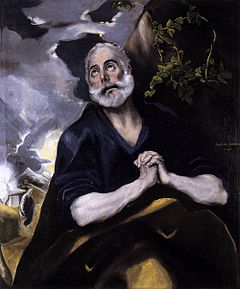
Repentance of Peter by El Greco, 1580–1586.
Further waves of "Counter-Reformation art" occurred when areas formerly Protestant were again brought under Catholic rule. The churches were normally empty of images, and such periods could represent a nail time for artists. The best known instance is the new Castilian Netherlands (essentially modern Belgium), which had been the center of Protestantism in the netherlands but became (initially) exclusively Catholic after the Castilian drove the Protestants to the north, where they established the United Provinces. Rubens was one of a number of Flemish Baroque painters who received many commissions, and produced several of his best known works re-filling the empty churches.[thirty] Several cities in French republic in the French wars of faith and in Germany, Bohemia and elsewhere in the Xxx Years War saw like bursts of restocking.
The rather extreme pronouncement past a synod in Antwerp in 1610 that in futurity the cardinal panels of altarpieces should only prove New Attestation scenes was certainly ignored in the cases of many paintings by Rubens and other Flemish artists (and in detail the Jesuits continued to commission altarpieces centred on their saints), but nevertheless New Testament subjects probably did increase.[31] Altarpieces became larger and more than easy to make out from a altitude, and the large painted or gilded carved wooden altarpieces that were the pride of many northern late medieval cities were often replaced with paintings.[32]
Some subjects were given increased prominence to reflect Counter-Reformation emphases. The Repentance of Peter, showing the end of the episode of the Denial of Peter, was non ofttimes seen earlier the Counter-Reformation, when it became popular as an assertion of the sacrament of Confession confronting Protestant attacks. This followed an influential book by the Jesuit Central Robert Bellarmine (1542–1621). The epitome typically shows Peter in tears, as a half-length portrait with no other figures, ofttimes with easily clasped as at right, and sometimes "the cock" in the background; it was oftentimes coupled with a repentant Mary Magdalen, another exemplar from Bellarmine'south volume.[33]
As the Counter-Reformation grew stronger and the Catholic Church felt less threat from the Protestant Reformation, Rome one time once again began to affirm its universality to other nations around the earth. The religious guild of the Jesuits or the Society of Jesus, sent missionaries to the Americas, parts of Africa, India and east asia and used the arts as an effective ways of articulating their message of the Catholic Church's authority over the Christian religion. The Jesuits' bear upon was so profound during their missions of the fourth dimension that today very similar styles of art from the Counter-Reformation menstruation in Catholic Churches are found all over the world.
Despite the differences in approaches to religious art, stylistic developments passed near as quickly beyond religious divisions every bit within the two "blocs". Artistically Rome remained in closer touch with the netherlands than with Spain.
Notes [edit]
- ^ a b Spicer, Andrew (5 Dec 2016). Lutheran Churches in Early on Modern Europe. Taylor & Francis. p. 237. ISBN9781351921169.
As it developed in northward-eastern Frg, Lutheran worship became a complex ritual choreography set in a richly furnished church interior. This much is evident from the background of an epitaph painted in 1615 by Martin Schulz, destined for the Nikolaikirche in Berlin (come across Figure five.5.).
- ^ a b c d due east f Lamport, Marker A. (31 Baronial 2017). Encyclopedia of Martin Luther and the Reformation. Rowman & Littlefield Publishers. p. 138. ISBN9781442271593.
Lutherans connected to worship in pre-Reformation churches, generally with few alterations to the interior. Information technology has even been suggested that in Germany to this twenty-four hours i finds more ancient Marian altarpieces in Lutheran than in Cosmic churches. Thus in Germany and in Scandinavia many pieces of medieval art and architecture survived. Joseph Leo Koerner has noted that Lutherans, seeing themselves in the tradition of the ancient, apostolic church, sought to defend as well as reform the employ of images. "An empty, white-done church proclaimed a wholly spiritualized cult, at odds with Luther's doctrine of Christ's real presence in the sacraments" (Koerner 2004, 58). In fact, in the 16th century some of the strongest opposition to destruction of images came not from Catholics but from Lutherans confronting Calvinists: "Y'all black Calvinist, you give permission to smash our pictures and hack our crosses; we are going to smash you and your Calvinist priests in return" (Koerner 2004, 58). Works of art continued to be displayed in Lutheran churches, often including an imposing large crucifix in the sanctuary, a clear reference to Luther'southward theologia crucis. ... In dissimilarity, Reformed (Calvinist) churches are strikingly different. Normally unadorned and somewhat defective in aesthetic entreatment, pictures, sculptures, and ornate altar-pieces are largely absent; there are few or no candles; and crucifixes or crosses are also mostly absent.
- ^ The Reformation and Counter-Reformation. Historicist and Causes of the Reformation. New Advent.
- ^ Picken, Stuart D.B. (16 December 2011). Historical Dictionary of Calvinism. Scarecrow Press. p. 1. ISBN9780810872240.
While Frg and the Scandinavian countries adopted the Lutheran model of church and country, French republic, Switzerland, the Netherlands, Hungary, what is now the Czech Republic, and Scotland created Reformed Churches based, in varying ways, on the model Calvin prepare in Geneva. Although England pursued the Reformation ideal in its own mode, leading to the germination of the Anglican Communion, the theology of the Thirty-Nine Articles of the Church of England were heavily influenced by Calvinism.
- ^ Nuechterlein, Jeanne Elizabeth (2000). Holbein and the Reformation of Art. University of California, Berkeley.
- ^ Marquardt, Janet T.; Hashemite kingdom of jordan, Alyce A. (fourteen January 2009). Medieval Art and Architecture later the Middle Ages. Cambridge Scholars Publishing. p. 71. ISBN9781443803984.
In fact, Lutherans often justified their continued apply of medieval crucifixes with the same arguments employed since the Middle Ages, as is evident from the example of the altar of the Holy Cross in the Cistercian church building of Doberan.
- ^ Michalski, 89
- ^ Dixon, C. Scott (9 March 2012). Contesting the Reformation. John Wiley & Sons. p. 146. ISBN9781118272305.
Co-ordinate to Koerner, who dwells on Lutheran fine art, the Reformation renewed rather than removed the religious image.
- ^ Noble, 19, notation 12
- ^ Institutes, i:xi, department 7 on crosses
- ^ Campbell, Lorne, Renaissance Portraits, European Portrait-Painting in the 14th, 15th and 16th Centuries, p. 193, 1990, Yale, ISBN 0300046758; Hales was the brother of John Hales (died 1572)
- ^ Michalski, 87-88
- ^ Michalski, 73-74
- ^ Michalski, 72-73
- ^ Michalski, 84. Google books
- ^ Kleiner, Fred S. (i January 2010). Gardner's Art through the Ages: A Concise History of Western Art. Cengage Learning. p. 254. ISBN9781424069224.
In an episode known as the Great Iconoclasm, bands of Calvinists visited Catholic churches in holland in 1566, shattering stained-glass windows, smashing statues, and destroying paintings and other artworks they perceived as idolatrous.
- ^ Marshall, Peter (22 Oct 2009). The Reformation. Oxford University Press. p. 114. ISBN9780191578885.
Iconoclastic incidents during the Calvinist 'Second Reformation' in Frg provoked reactive riots by Lutheran mobs, while Protestant prototype-breaking in the Baltic region deeply antagonized the neighbouring Eastern Orthodox, a group with whom reformers might have hoped to make mutual cause.
- ^ Mattox, Mickey L.; Roeber, A. G. (27 February 2012). Irresolute Churches: An Orthodox, Catholic, and Lutheran Theological Conversation. Wm. B. Eerdmans Publishing. p. 54. ISBN9780802866943.
In this "sacramental union," Lutherans taught, the torso and blood of Christ are and so truly united to the bread and wine of the Holy Communion that the two may be identified. They are at the same fourth dimension trunk and blood, bread and wine. This divine food is given, more-over, not just for the strengthening of faith, nor only as a sign of our unity in faith, nor merely as an balls of the forgiveness of sin. Fifty-fifty more, in this sacrament the Lutheran Christian receives the very torso and blood of Christ precisely for the strengthening of the matrimony of religion. The "real presence" of Christ in the Holy Sacrament is the ways past which the union of faith, effected past God's Discussion and the sacrament of baptism, is strengthened and maintained. Intimate union with Christ, in other words, leads directly to the most intimate communion in his holy body and blood.
- ^ Trevor-Roper, 98-101 on Rudolf, and Stiff, Pt. ii, Chapter 3 on France, especially pp. 98-101, 112-113.
- ^ Art in Renaissance Italia. Paoletti, John T., and Gary M. Radke. Pg. 514.
- ^ Text of the 25th decree of the Council of Trent
- ^ Blunt Anthony, Artistic Theory in Italy, 1450-1660, chapter VIII, especially pp. 107-128, 1940 (refs to 1985 edn), OUP, ISBN 0-nineteen-881050-4
- ^ The expiry of Medieval Art Extract from book by Émile Mâle
- ^ Fine art of the Reformation and Counter-Reformation. Nosotro, Rit.
- ^ The Art of the Counter Reformation. Metropolitan Museum of Fine art.
- ^ a b Lamport, Mark A. (31 August 2017). Encyclopedia of Martin Luther and the Reformation. Rowman & Littlefield Publishers. p. 138. ISBN9781442271593.
- ^ (Sidney) Freedberg, 427–428, 427 quoted
- ^ "Transcript of Veronese'due south testimony". Archived from the original on 2009-09-29. Retrieved 2007-03-26 .
- ^ David Rostand, Painting in Sixteenth-Century Venice: Titian, Veronese, Tintoretto, 2d ed 1997, Cambridge Upwardly ISBN 0-521-56568-v
- ^ (David) Freedberg, throughout
- ^ (David) Freedberg, 139-140
- ^ (David) Freedberg, 141
- ^ Hall, pp. 10 and 315
References [edit]
- David Freedberg, "Painting and the Counter-Reformation", from the catalogue to The Age of Rubens, 1993, Boston/Toledo, Ohio, online PDF
- Freedburg, Sidney J. Painting in Italy, 1500–1600, 3rd edn. 1993, Yale, ISBN 0300055870
- James Hall, A History of Ideas and Images in Italian Art, 1983, John Murray, London, ISBN 0-7195-3971-4
- Michalski, Sergiusz. Reformation and the Visual Arts: The Protestant Prototype Question in Western and Eastern Europe, Routledge, 1993, ISBN 0-203-41425-10, 9780203414255 Google Books
- Noble, Bonnie (2009). Lucas Cranach the Elder: Art and Devotion of the German Reformation. University Press of America. ISBN978-0-7618-4337-5.
- Roy Potent; Art and Power; Renaissance Festivals 1450-1650, 1984, The Boydell Printing;ISBN 0-85115-200-7
- Trevor-Roper, Hugh; Princes and Artists, Patronage and Credo at Four Habsburg Courts 1517-1633, Thames & Hudson, London, 1976, ISBN 0-500-23232-half-dozen
Further reading [edit]
- Avalli-Bjorkman, Gorel. "A Bolognese Portrait of a Butcher." The Burlington Magazine 141 (1999).
- Caldwell, Dorigen. "Reviewing Counter-Reformation Art." 5 February. 2007 [one].
- Christensen, Carl C. "Art and the Reformation in Germany." The Sixteenth Century Periodical Athens: Ohio UP, 12 (1979): 100.
- Coulton, Thousand Chiliad. "Art and the Reformation Reviews." Art Bulletin 11 (1928).
- Honig, Elizabeth. Painting and the Market in Early Modern Antwerp. New Oasis: Yale UP, 1998.
- Koerner, Joseph Fifty. The Reformation of the Image. London: The University of Chicago P, 2004.
- Knipping, John Baptist, Iconography of the Counter Reformation in the Netherlands: Heaven on Earth 2 vols, 1974
- Mayor, A. Hyatt, "The Art of the Counter Reformation." The Metropolitan Museum of Fine art Message four (1945).
- Silver, Larry. Peasant Scenes and Landscapes: the Rise of Pictorial Genres in the Antwerp Art Market. Philadelphia: University Pennsylvania P, 2006.
- Wisse, Jacob. "The Reformation." In Timeline of Art History. New York: The Metropolitan Museum of Art, 2000- [ii] (Oct 2002).
External links [edit]
- Review of The Reformation of the Image past Joseph Leo Koerner, by Eamon Duffy, London Review of Books
Source: https://en.wikipedia.org/wiki/Art_in_the_Protestant_Reformation_and_Counter-Reformation
0 Response to "17 What Role Does the Counterreformation Play in the Development of Italian Baroque Art?"
Post a Comment